

Picture Books About Japanese Internment in the United States

March 10, 2026

First proclaimed by then President Franklin Roosevelt on February 19, 1942, Executive Order 9066 mandated the internment, or more accurately, the forcible removal and incarceration of persons of Japanese descent living in the United States. By the time the last of ten total concentration camps closed on March 20, 1946, over 120,000 people, including children and their families, had been imprisoned for the sole crime of being Japanese. 
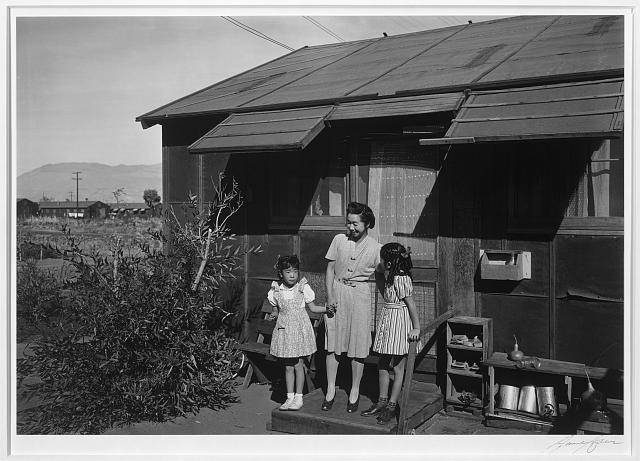
woman and 2 young girls outside an internment cabin
Mrs. Yaeko Nakamura and her two children, Joyce Yuki (right) and Louise Tami (left), standing on the step at the entrance of a dwelling, Manzanar Relocation Center. Photograph by Ansel Adams, 1943. Courtesy of Library of Congress. 

In tumultuous times—as was the case during the Second World War—there is always the temptation for some people, especially those in positions of power, to scapegoat and persecute others in a seeming attempt to feel safe or in control. The history of Japanese interment in the U.S., however, shows us that turning against our neighbors is never the answer. 

How do we teach young children about this period in history, then? In the early childhood or preschool classroom, what is important is teaching and modeling empathy, not granular historical details. But school aged children are more than capable of learning this history, and picture books are a great place to start. In this blog post, we highlight titles from our collection that have Japanese internment as a central focus. 

Librarians love any book that highlights the power of books and libraries, and Love in the Library is a perfect example. Author Maggie Tokuda-Hall based this book on her real life grandparents, who met while both were incarcerated at Minidoka, a concentration camp in Idaho. This standout picture book movingly illustrates what it to be human, to believe that there is a "miracle in all of us" even when our circumstances are anything but. It is a gentle, age-appropriate read for school age children and their adults. 

Some people know George Takei namely as the actor who famously portrayed Hikaru Sulu on Star Trek. Others may know him as an activist and author, particularly of memoirs that depict his experiences under incarceration during the Second World War. In My Lost Freedom, Takei brings his experiences to life for younger readers. 

Although he had not yet started school, Takei was incarcerated along with this family in Arkansas, far from their hometown of Los Angeles. Yet his parents, and his mother in particular, made the camp home despite it not being a fit place for anyone. Takei's picture book biography also covers the period after which families were released from the camps, often with little money and no homes to return to. Back matter at the end of the book includes a glossary of Japanese terms, photographs of the Takei family, and an author's note. 

Picture Books About Japanese Internment in the United States

For more picture books about this important topic, see our catalog widget above. If you are looking for teaching resources, check out the website for Densho.org. There are digital collections of photographs and oral histories,  lesson plans, videos, and more. As this website notes, history may not always repeat itself, but it often rhymes. In other words, we often find ourselves repeating the mistakes of the past because we have not learned. The only way we will stop this cycle is if we learn tough histories and do not shy away from discomfort or challenges. 

Klem-Mari Cajigas

Klem-Mari

In a former life, Klem-Marí was a Religious Studies scholar. She much prefers being the Family Literacy Coordinator for Bringing Books to Life! She wants you to read and share books with the children in your life, and for those children to see you to read as well. Originally from Puerto Rico, Klem-Marí also enjoys her cat, baking, yoga, and the works of Octavia Butler.