
Banned Books Club: Maus

February 15, 2026

Book Title: Maus: A Survivor's Tale (Volumes I & II)

Author: Art Spiegelman

First Published: 1986 (Volume I) & 1991 (Volume II)

Why It's Been Challenged:

  • Contains "inappropriate imagery" (brief nudity)
  • "Graphic language"
  • "Disturbing" depictions of violence and death
  • "Not age-appropriate" for students
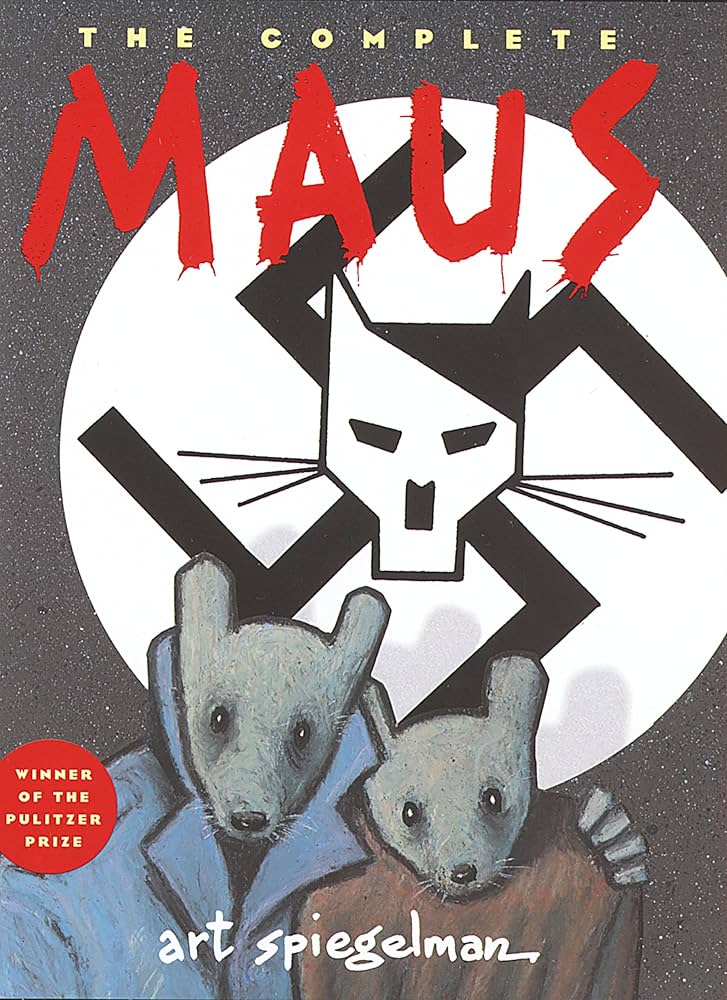
maus book cover

The Story

Maus is a graphic novel that tells the story of Vladek Spiegelman's survival during the Holocaust through conversations between Art and his father. 

The narrative moves between two timelines: Vladek's experiences in Poland during World War II and the 1970s-1980s conversations where he recounts these memories to his son. It's both a Holocaust memoir and a story about intergenerational trauma, showing how historical horror can ripple through families.

The work took thirteen years to complete and became the first graphic novel to win a Pulitzer Prize.

The "Issues"

In early 2022, Maus gained national attention when a Tennessee school board voted to remove it from eighth-grade curriculum, calling it "inappropriate." The irony was not lost on many: banning a book about the dangers of authoritarianism and the systematic silencing of voices.

Critics claim:

  • It contains "inappropriate" imagery: There is exactly one small panel showing Spiegelman's mother in a bathtub after her suicide. This moment of nudity appears in the context of profound grief and mental illness. If we cannot handle a tasteful depiction of the human form in the context of tragedy, how can we claim to be preparing students for the realities of history and literature?

  • The language is "inappropriate": The book contains some profanity and racial slurs, which is simply language that reflects the historical reality of the Holocaust. Sanitizing historical accountsdiminishes victims' experiences. 

  • It's too "disturbing" for young people: Maus actually handles Holocaust horrors with remarkable restraint compared to purely historical accounts. The animal allegory creates necessary distance while still showing the gravity of genocide. If eighth-graders can handle reading about slavery, war, and other historical atrocities, they can handle Maus.

Why It Matters

Maus proved that graphic novels could tackle serious subjects and that alternative storytelling formats could reach readers in ways traditional texts cannot.

For students, it offers an accessible entry point into Holocaust education that doesn't overwhelm but also doesn't minimize. It shows how historical trauma affects survivors and their children; that is, it teaches a lesson crucial for understanding intergenerational effects of any historical injustice.

For educators, it helps them team their students to interpret visual metaphors, and analyzing how medium shapes message.

Final Thoughts

When we remove books that document historical atrocities, we're not protecting children. Instead, we're protecting ourselves from having difficult conversations.

Every time someone bans a book about the Holocaust, they prove why such books are necessary. They demonstrate that we haven't learned the lessons we claim to have learned.

Children need adults brave enough to say: "This happened. This is how someone survived it. This is how his son tried to understand it. These are stories we must not forget."

Jessica

Jessica

Jessica is an Adult Services librarian at the Hermitage Branch. She fully embraces the librarian cliché by surrounding herself with books, writing, coffee, cats, and an undeniable love for cardigan weather. When she’s not recommending great reads, she’s either editing her latest novel or trying to keep up with her toddler—both of which require an impressive amount of caffeine.

Genre / Topics

Age Groups