


You know that quiet panic that creeps in when you eat the "wrong" thing, skip a workout, struggle with your mental health, or get a lab result showing elevated cholesterol and that inner critic whispers, "If you really cared about yourself, you wouldn't be like this." That voice doesn't come out of nowhere; it's shaped by a culture that treats health like a moral obligation, where being "well" means being "good."
Some scholars call this “healthism” — the idea that health is solely an individual's personal responsibility and a reflection of their worth. In this worldview, if you’re sick, fat, disabled, burned out, or simply struggling, the problem is assumed to be you — not your environment, history, access to support, or the systems surrounding your life. Healthism reduces health and wellness to willpower, promoting a popular fairytale: if you just try hard enough, you can be perfectly well.
Where Healthism Comes From
The term “healthism” was coined in 1980 by sociologist Robert Crawford, who described it as a new “health consciousness” that shifts responsibility for wellness onto individuals while leaving social inequities unaddressed. It medicalizes everyday life: sleep, food, movement — even relationships — filtering them through a health lens. On the surface, that can sound empowering — “take charge of your health, take charge of your life” — but beneath that message lies quiet blame, suggesting that lack of health signals lack of effort.
How Healthism Shows Up
Healthism rarely announces itself by name — most people outside of health and wellness-related fields have never even heard the term — but it echos through everyday moments like these:
- "If they'd just eat better and exercise, they wouldn't have [insert health issue]," or a nutritionist warning that "carbs cause diabetes."
- Advising someone on the "healthiest" way to give birth or form a family.
- Urging someone to "push through" the pain of a workout or a yoga pose.
- Constantly checking health metrics or lab results, Googling how every food might affect your body, or skipping social events out of fear of not eating "clean."
- Wellness spaces that center thin, affluent, non-disabled bodies as the "norm."
- Simplistic mental health narratives such as "depression is just a chemical imbalance."
Beneath those ideas sits a hazardous assumption: that health is entirely controllable, and "good" people manage it successfully. That belief erases genetics, environment, trauma, discrimination, and the countless social determinants that shape our bodies and minds.
A More Compassionate View of Wellness
For people living with trauma, chronic illness, disability, or ongoing oppression, healthism can feel like a personal indictment. It tells survivors they should “just relax” or heal themselves without recognizing unsafe conditions, limited access to care, or cultural barriers. It tells people who are overworked or underserved that mindset--not policy or history--is to blame.
A compassionate approach to health and wellness starts with a simple truth: your body is not a moral project; it’s a living archive of everything you’ve endured and overcome. We know that health and wellness are strongly influenced by housing, employment, racism, gendered violence, access to care, literacy, education, various systems of harm, and so much more — not just “choices.” From this perspective, rest becomes resistance, care becomes collective, and the goal shifts from perfection to balance.
Be Well at NPL: Wellness for All
Instead of asking, “How do I become the healthiest version of myself?” we might ask:
- "What does feeling a bit more resourced look like for me, given my life right now?"
- "How can health be something we build together — through community and care — not something I have to earn or buy alone?"
- "What would it mean to treat my body as worthy and learn more about it, even when it's tired or healing?"
This isn't about giving up on caring for your body, it's about loosening the grip of shame, guilt, comparison, and understanding that health is not a competition.
Be Well at NPL offers something radical: a space where healthcare feels like a library. Here, wellness is free, inclusive, curious, and wrapped in community care. You might find families laughing as they trade recipes from their cultures in a cooking class, parents connecting in an infant massage workshop, or participants learning about acceptance in trauma-aware meditations or sound baths. Seated stretches, chair yoga, and adaptive movement classes make space for every body, and nutrition literacy centered on balance and empowerment, not elimination diets or blame.
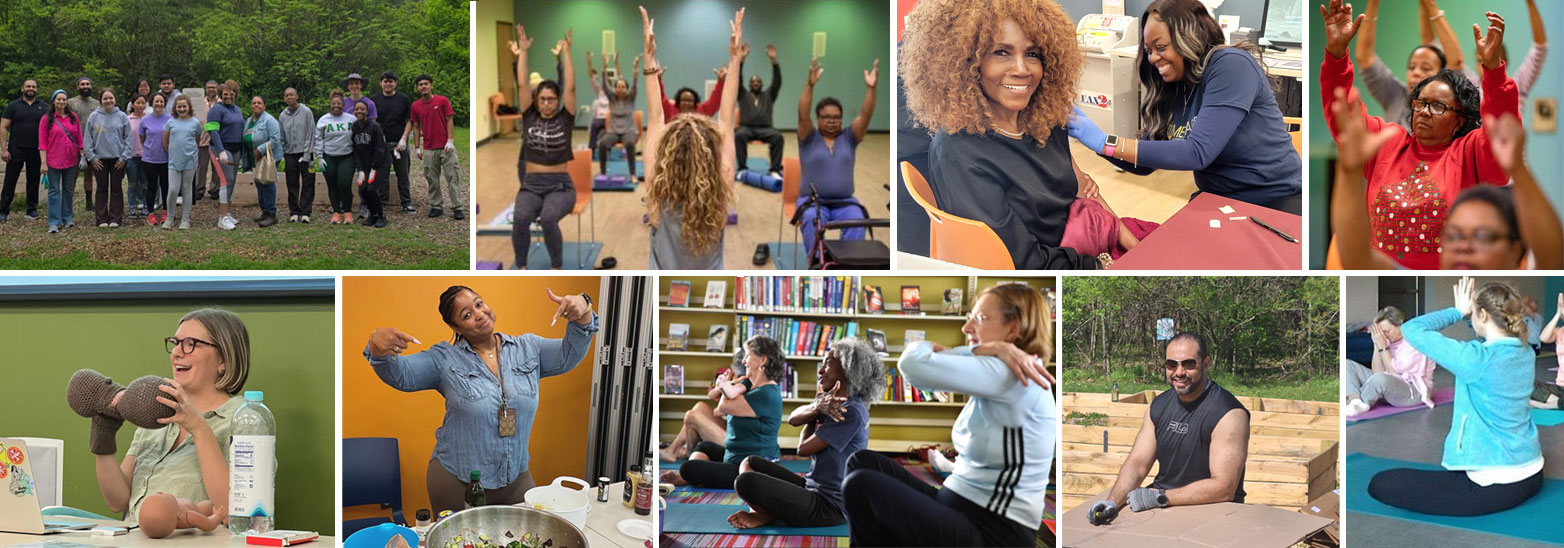
Our programs dismantle the myth that health is a luxury. Cooking workshops and community gardens help counter food deserts. Lactation counseling and labor prep workshops bring caregivers in solidarity. Restorative spaces for our youth coming to a dance class or a workshop. This reminds us that rest itself is a form of collective healing and health begins with literacy.
Reimagined through community, our wellness becomes something shared — a rhythm, not a race.
If you're in Nashville, come to a Be Well event. If you're elsewhere, let it spark an idea for your neighborhood library, or reach out to me, connect, and keep building community and this conversation going.
Health belongs to all of us, so we build it together.
Be Well.
